



FOLLOW US


 .jpg)

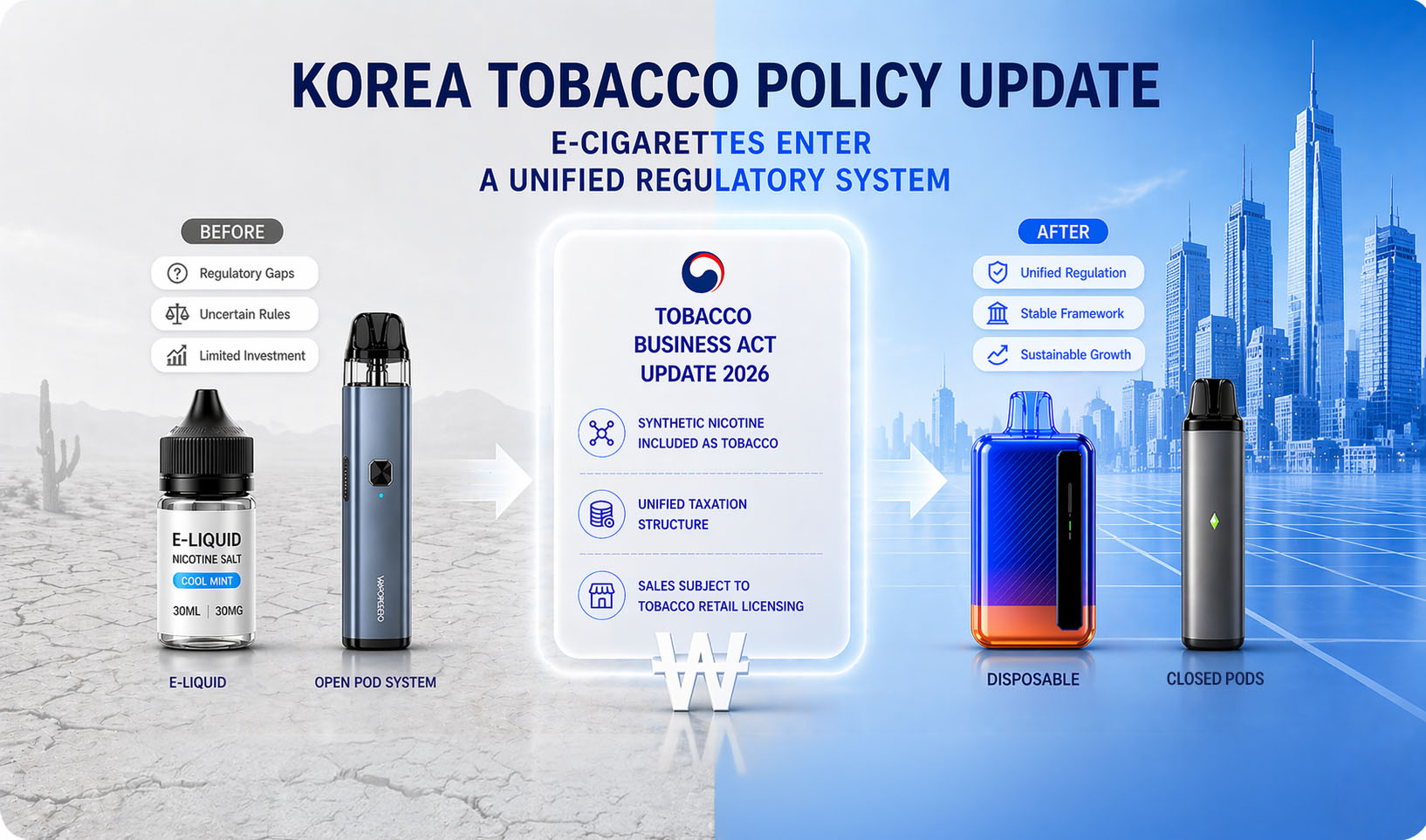
On April 24, 2026, Korea’s revised Tobacco Business Act officially came into effect. This revision formally brings synthetic nicotine into the national tobacco regulatory framework, clarifying their legal status and ending the long-standing ambiguity surrounding their regulation. This change will directly impact channel confidence, pricing structures, and product formats in the Korean e-cigarette market.
This article analyzes the implications from three perspectives: policy background, market impact, and emerging opportunities.
Policy Background 정책 배경
E-Cigarettes Enter a Unified Regulatory System
The Korean e-cigarette market has long operated under regulatory gaps. Synthetic nicotine products were not fully classified as tobacco, allowing certain products to bypass tobacco taxation and sales restrictions. While e-cigarettes were legally sold, the absence of a unified framework limited long-term investment from both channels and enterprises.
The key changes are reflected in three areas:
Inclusion of synthetic nicotine under the tobacco definition
The regulatory scope has expanded from “tobacco leaf-based products” to “nicotine-containing products.” Synthetic nicotine e-liquids are now officially classified as tobacco products, eliminating previous opportunities to bypass regulation and taxation through formulation differences.
Unified taxation structure for e-cigarettes
Synthetic nicotine e-liquids are taxed on a per-milliliter basis, aligning the tax structure with traditional nicotine-based e-liquids. The establishment of a formal tax system positions e-cigarettes as a stable source of government revenue while reinforcing their legal and regulatory foundation.
Sales subject to tobacco retail licensing
E-cigarette sales must comply with tobacco retail licensing requirements, including channel access control, youth protection, and restrictions on advertising and promotion. Market entry barriers have significantly increased.
The policy officially took effect in April 2026. The government also introduced a two-year transitional period, applying a 50% reduction to key tobacco-related taxes, including the Tobacco Consumption Tax and Individual Consumption Tax, to ease market disruption during implementation. During this period, companies are expected to monitor policy outcomes and adjust product structures and strategies accordingly.
Market Impact 시장 영향
Channels, Pricing, and Product Formats
The market response follows a clear transmission path. Channel dynamics shift first, followed by pricing changes, which ultimately reshape product structures.
Pricing 가격
Taxation Drives Significant Increase in E-Liquid Costs
Pricing changes directly affect consumer demand for e-liquids. Previously, synthetic nicotine products were not classified as tobacco and could avoid tobacco taxation, resulting in relatively low retail prices. Following the policy update, synthetic nicotine e-liquids are taxed under the unified system, significantly increasing retail costs.
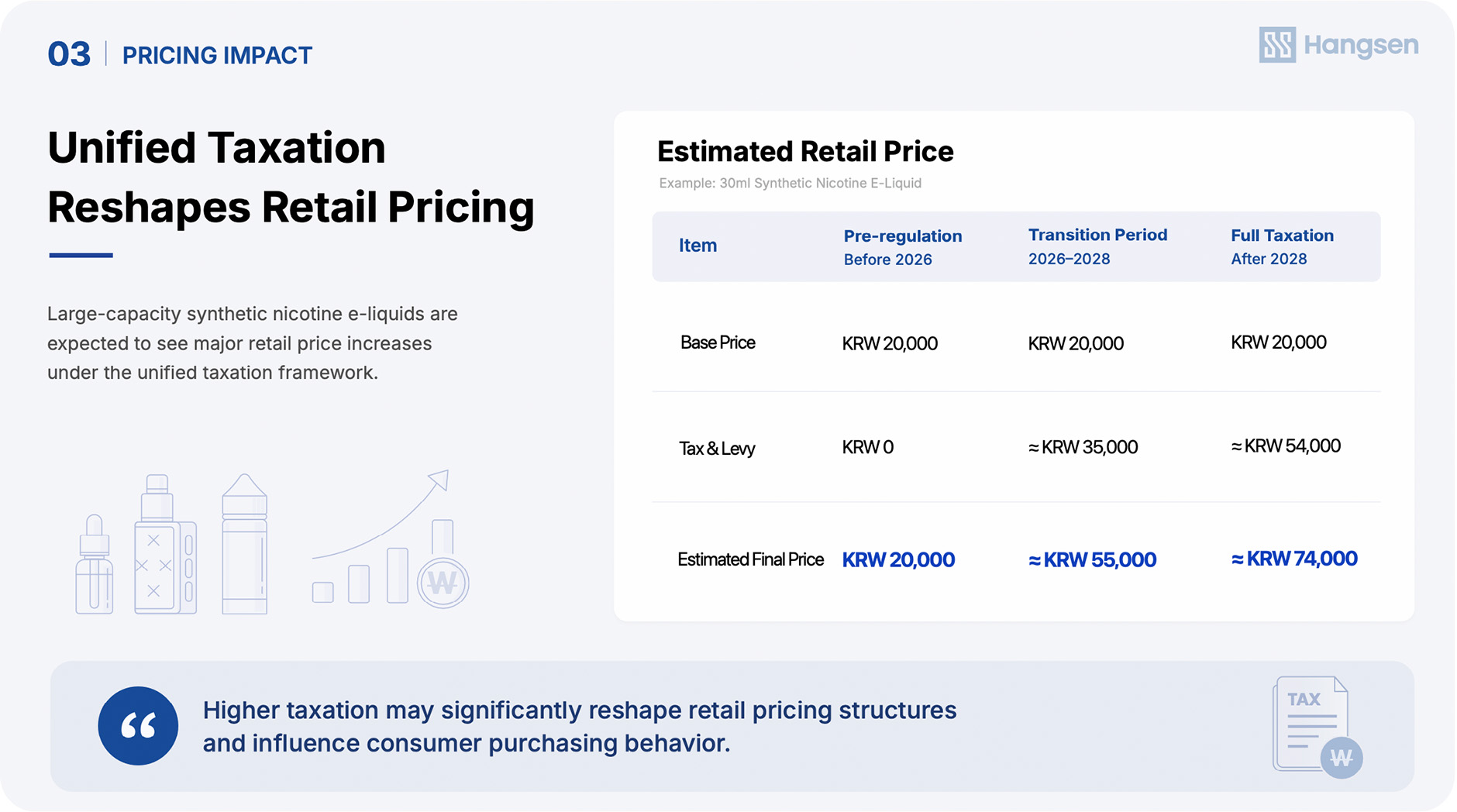
This will significantly reduce consumer willingness to purchase bottled e-liquids and reshape the overall hardware consumption landscape.
Product Format 제품
Shift from Open Systems to Closed Systems
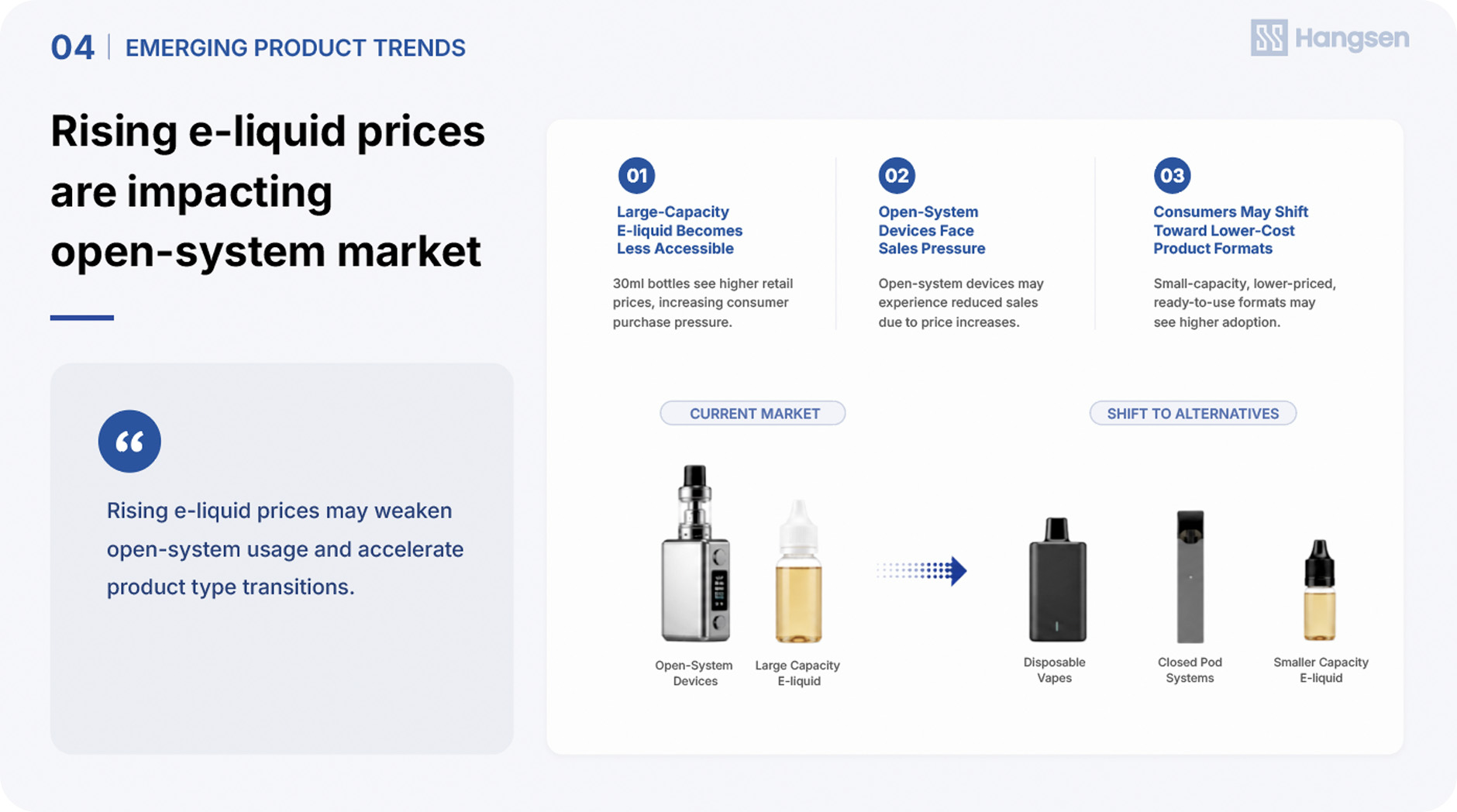
Price increases may put pressure on the open-system segment. Because these products rely heavily on bottled e-liquids, higher e-liquid prices may raise refill costs and gradually weaken the attractiveness of open-system products.
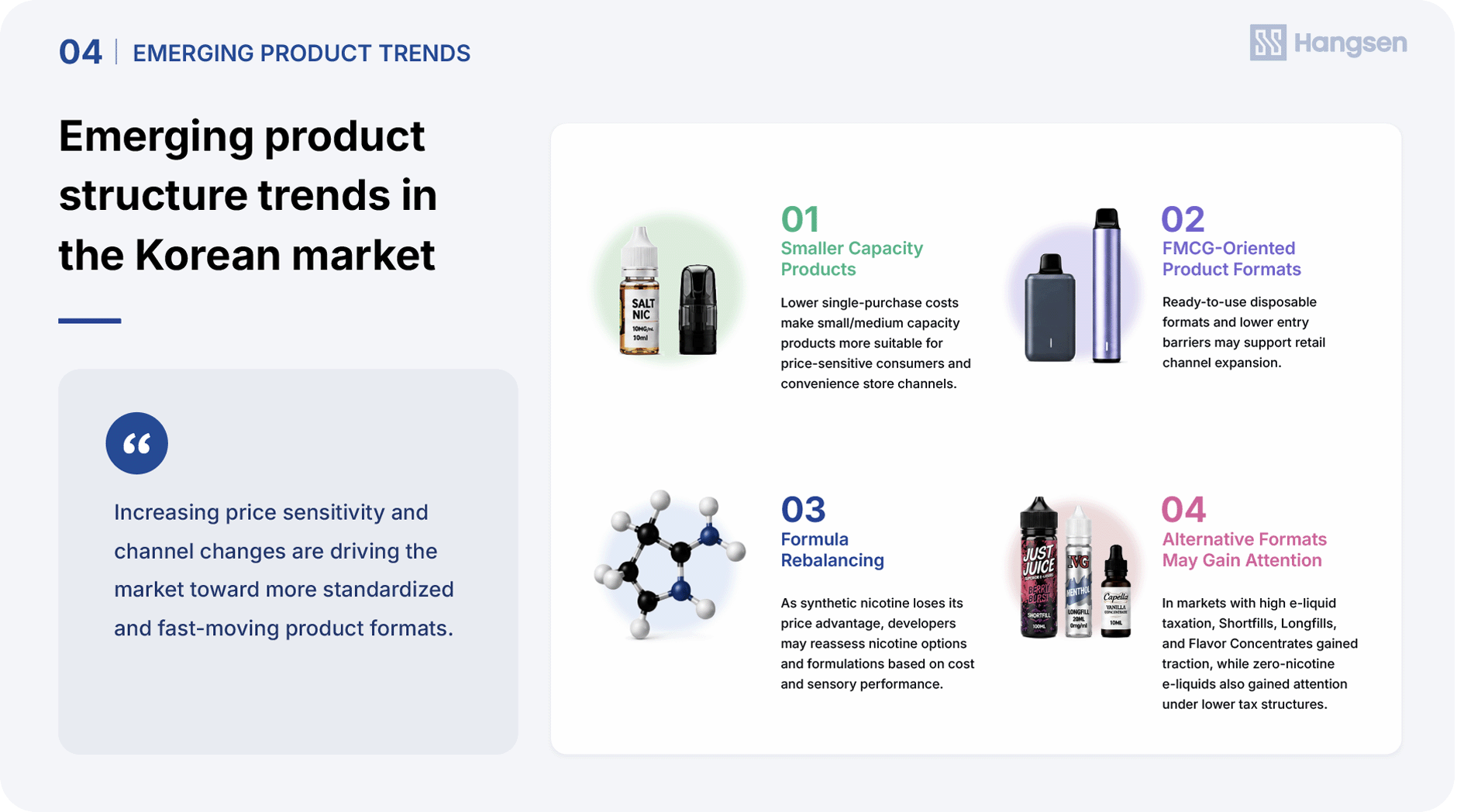
Retail channel logic further reinforces this shift. Convenience stores favor products with lower unit prices, lower usage barriers, and immediate usability. Compared with open systems, closed pod systems and disposable e-cigarettes align more closely with retail requirements. Their simplified product structures, lower upfront costs, and shorter decision cycles make them better suited for convenience store and supermarket channels. As a result, disposable and closed pod products may gain a larger share of Korea’s future vape market.
Product capacity structures will also shift. Large-capacity e-liquid products face higher tax burdens and retail prices, while small- and medium-capacity products may become more accessible due to lower single-purchase costs and stronger compatibility with FMCG retail circulation. In channels such as convenience stores, where sales efficiency per unit area is highly valued, compact formats around 2ml or below may become increasingly aligned with mainstream retail requirements and gain broader offline penetration.
The share of synthetic nicotine e-liquids is expected to decline. Synthetic nicotine will lose part of its previous tax advantage while remaining more expensive than conventional nicotine. For products that have already achieved large-scale sales, some companies may consider reformulating around conventional nicotine salts to reduce raw material costs and improve profit margins.
Alternative e-liquid formats may also gain greater attention. In markets with high e-liquid taxation, formats such as Shortfills, Longfills, Flavor Concentrates, and zero-nicotine e-liquids have gained market space as alternative product structures. Whether Korea follows a similar path will depend on how future policies define product categories and whether taxation rules become further differentiated.
Channel 채널
Compliant Retail Channels Confidence Rebuilding
Convenience stores and large retail channels in Korea have historically taken a cautious approach to e-cigarettes and remain highly sensitive to policy signals. In October 2019, the U.S. vaping-related lung illness crisis drew regulatory attention in Korea. The Ministry of Health and Welfare subsequently advised the public to refrain from using e-cigarettes and initiated related investigations.
.jpg "POLICY SENSITIVITY- KOREAN vape RETAIL channels_ (1).jpg")
Retail channels responded rapidly. Major convenience store chains, including GS25, CU, 7-Eleven, and Emart24, suspended sales or halted restocking of e-cigarette products, including Juul Labs pods and KT&G’s Siid Tundra, while allowing existing inventory to be cleared. At the same time, Emart suspended sales of Viento and RELX products, and duty-free channels also removed Juul Labs and KT&G products. Following the incident, major retail channels remained cautious toward e-cigarettes, limiting further channel expansion.
With the regulatory framework becoming more comprehensive, the category gains a more stable long-term operating environment, helping mainstream retail channels reassess participation and commercial opportunities.
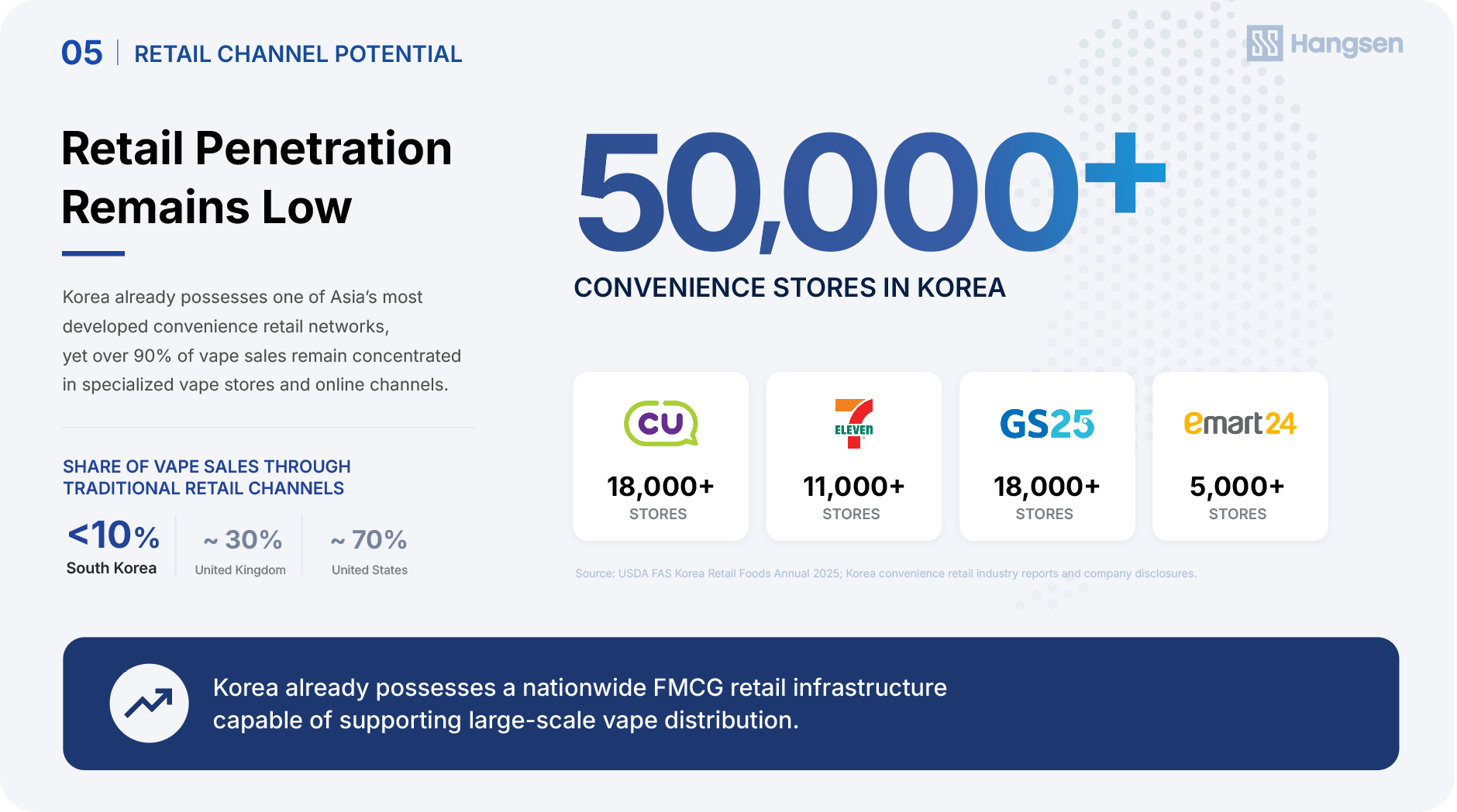
At present, convenience stores still account for less than 10% of Korea’s e-cigarette retail sales, indicating that the channel remains underdeveloped compared with its store density and consumer accessibility. One of the main reasons has been the long-standing regulatory uncertainty surrounding synthetic nicotine products, combined with the high policy sensitivity of Korea’s mainstream retail sector toward e-cigarettes. As a result, vape sales have historically relied more heavily on specialty vape stores and online-oriented distribution channels.
As online sales restrictions become stricter and the licensing system for tobacco and nicotine product sales is more clearly enforced, part of consumer demand is expected to gradually shift toward licensed offline retail channels. At the same time, as synthetic nicotine products are incorporated into the formal tax and regulatory framework, previous pricing and less-regulated channel differences are expected to narrow, further improving the competitiveness of convenience stores and other compliant offline retail channels.
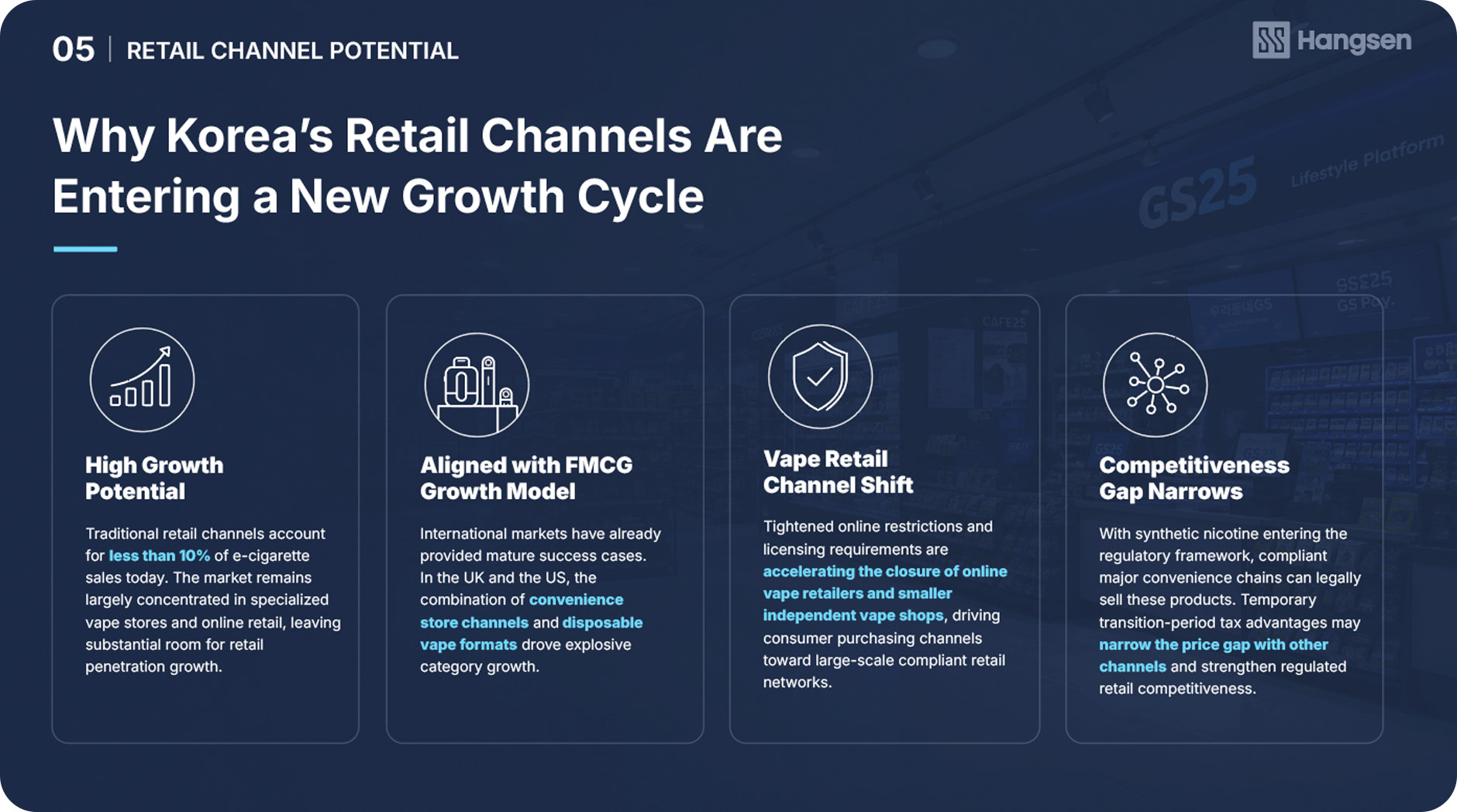
This creates space for channel restructuring. Large retail chains may gradually reassess the category’s commercial value, restore product listings, expand shelf space, and build more stable partnerships with compliant brands. Supported by Korea’s high-density convenience store network of approximately 50,000 outlets, disposable e-cigarettes and other small-capacity, ready-to-use formats may become increasingly compatible with mainstream retail environments and gain stronger offline penetration over time.
Emerging Opportunities
Capturing Korea’s Next Growth Cycle
The Korean e-cigarette market is entering a new phase of more standardized and compliance-oriented operations. Regulatory restructuring, channel adaptation, and product format changes are gradually reshaping the market’s future growth logic.
Future opportunities are likely to concentrate around four key points:
As convenience store participation gradually increases under a clearer regulatory framework, brands aligned with mainstream retail requirements may gain stronger offline expansion opportunities. Korea’s nationwide convenience store infrastructure and high consumer accessibility provide a foundation for broader retail penetration.
Tax-driven pricing changes may accelerate the shift toward smaller, ready-to-use, and lower single-purchase-cost products. Disposable e-cigarettes, compact closed pod systems, and other retail-friendly formats may become increasingly compatible with FMCG retail environments.
As product structures become more standardized, flavor continuity and recognizable taste profiles may become increasingly important for user retention and smoother transitions from bottled e-liquid consumption. Brands capable of delivering stable and repeatable flavor experiences may gain stronger long-term competitiveness.
As compliance requirements, product complexity, and operational standards continue to increase, brands may place greater emphasis on manufacturing partners with stable supply chains, advanced formulation capabilities, scalable production systems, and regulatory experience.

Hangsen entered the Korean market as early as 2012, initially building consumer recognition through a B2C retail model before gradually transitioning to a B2B supply chain role. Over the years, Hangsen has supported major Korean tobacco groups and e-cigarette brands with OEM manufacturing, developing strong capabilities in product development, flavor adaptation, and large-scale production.
As the Korean market enters a new phase of structural transformation, a new window of opportunity is opening for emerging brands and market entrants. Hangsen welcomes collaboration to explore the next stage of growth in the Korean e-cigarette market.
For inquiries related to the Korean vape market e-liquid solutions, please get in touch with [email protected].
.png "KOREAN VAPING MARKET REPORT (1).png")
Learn more
South Korea Online Disposable Vape Market Snapshot
KOREA: Amendments to the Tobacco Business Act
Canada Vaping Market Snapshot 2026
Russian Vaping Market Snapshot 2026
TED Revision – European Commission Proposes Reform of Tobacco Taxation

 Previous