


FOLLOW US




North America is one of the most important regions for global vaping consumption and represents the largest regional market worldwide. Although the United States and Canada operate within the same North American market system and share broadly similar consumer cultures, the two markets have gradually diverged in terms of operating models, competitive structures, and accessibility for businesses.
Compared with the U.S. market, characterized by high concentration and greater uncertainty at both the entry and execution stages, the Canadian vaping market operates under relatively clear rules, retains a more diversified brand structure, and offers a more practical entry environment.
.png "canada_vaping_market (1).png")
Market Size and User Base
Market Size
Although Canada’s vaping market is significantly smaller than that of the United States, it remains within the global first tier when viewed from an international perspective. The country is estimated to have an established user base of more than 2 million adult vapers, providing a solid demand foundation for the market. According to Chinese customs export data for vaping products and related categories, Canada has consistently ranked among the world’s top ten import markets.
In terms of market value, Canada’s vaping market was estimated at approximately USD 1.1–1.2 billion in 2023–2024 and is expected to exceed USD 1.3 billion in 2025. Supported by an established user base, the market has maintained a relatively stable growth trajectory of around 10%, with limited volatility.
Market and User Characteristics
Canada’s vaping market has entered a relatively mature stage. Overall demand is primarily driven by adult smokers using vaping products as alternatives to combustible tobacco, with consumers showing high sensitivity to pricing, taxation, and supply stability.

From a device-structure perspective, the Canadian market is mainly composed of three categories:
Disposable Vapes
The user share of disposable vapes has increased from below 10% in the early stages to approximately 30% from 2023 through 2025, making them the fastest-growing device category. This growth has been driven mainly by ease of use and low entry barriers.
Closed Pod Vapes
Since 2020, closed pod devices have consistently maintained a user share of around 25%–30%. Despite periodic fluctuations, this segment has remained structurally stable and continues to occupy an important position among mature consumer groups.
Open System Devices
With the growth of disposable devices, the overall share of open system devices in the Canadian market has declined from over 80% in 2018 to around 40%. Within the open system category, the market has gradually shifted from traditional mod systems toward open pod formats. During this transition, open pod devices, supported by greater convenience and continuous product iteration, have steadily increased their share and become the mainstream option. In contrast, traditional mod systems, including sub-ohm tank mods and rebuildable atomizers such as RDA, RTA, and RDTA, have increasingly concentrated on a niche segment serving experienced users.
Overall, the market reflects a relatively balanced ecosystem in which long-established experienced users and newer user groups coexist, forming a clear and multi-layered consumption structure.
Competitive Landscape of the Canadian Vaping Market
Local brands have long occupied an important position at the retail level in Canada and represent an integral part of the overall market structure.
Within the vape shop channel, local brands such as Flavour Beast, STLTH, Vice, and Lemon Drop have established stable retail positions through mature local distribution networks and a sustained understanding of Canadian flavor preferences. These brands have maintained influence in the e-liquid segment while gradually expanding into disposable vapes and closed-system devices, achieving measurable scale at the retail level.

Overall, the Canadian vaping market has not yet entered a phase dominated by a small number of global brands. Competition among local brands remains relatively rational, providing viable operating space for small and mid-sized companies, with continued opportunities for new entrants.
Regulatory Framework for Vaping Products in Canada
Vaping products in Canada are regulated under the Tobacco and Vaping Products Act (TVPA), which formally incorporates vaping products into the national tobacco and nicotine regulatory framework.
At the federal level, the current regulatory requirements mainly include:
• A maximum nicotine concentration of 20 mg/mL
• Standardized packaging and health warning requirements
• Strict restrictions on advertising and promotional activities
• Inclusion of vaping products within the excise tax system
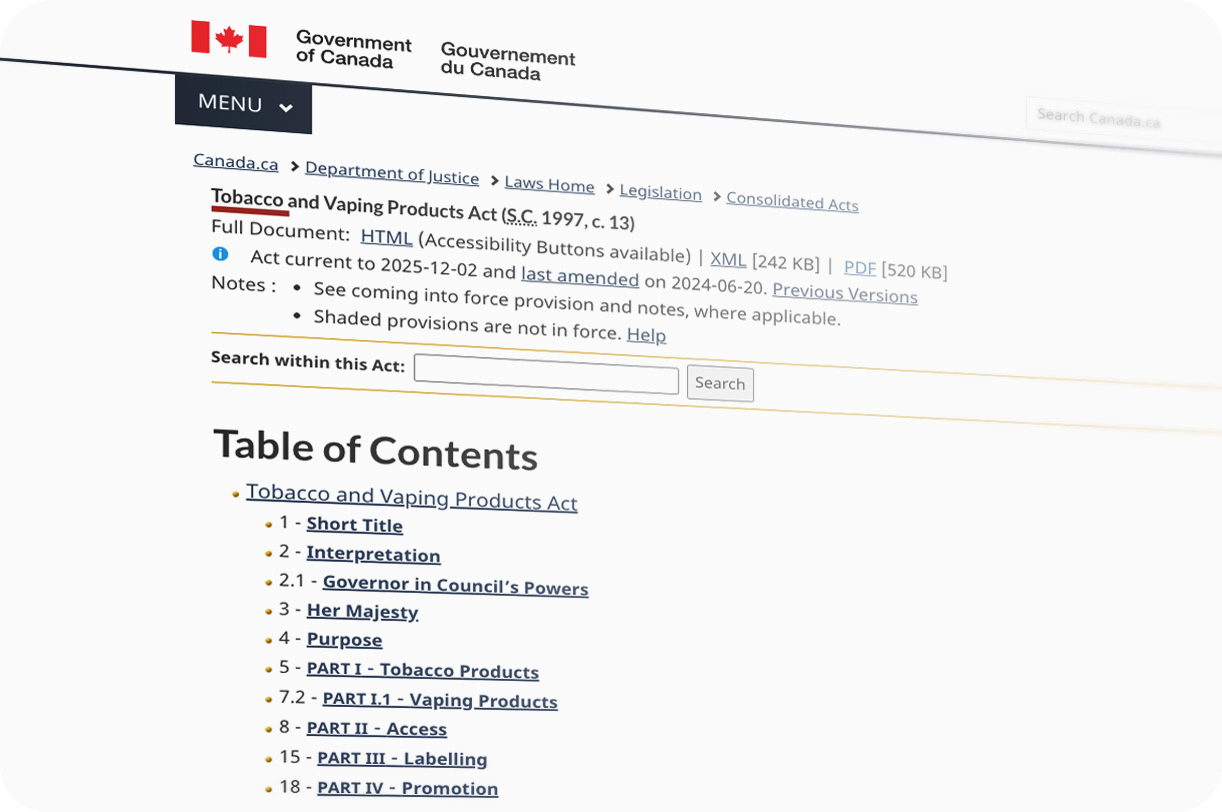
With respect to flavor regulation, Canada has not yet implemented a nationwide federal ban on vaping flavors. However, flavor management has become a policy variable with significant structural impact. Under the existing legal framework, the federal government retains room for further legislation, while provinces are permitted to adopt differentiated measures based on local public health policies.
In practice, provinces such as Quebec, Nova Scotia, New Brunswick, and Prince Edward Island have explicitly restricted vaping products to tobacco flavors only and have explicitly prohibited fruit, sweet, and other non-tobacco flavors. Other provinces have not implemented comprehensive bans but have significantly constrained flavor availability through measures such as limiting sales channels, tightening retail display rules, and restricting sales environments. Overall, Canada’s flavor regulation trajectory can be characterized as “province-led, uneven in execution, and gradually tightening.”
Taxes on E-Cigarettes in Canada
As of July 1, 2024, Canada applies its current federal excise duty framework to vaping products, administered by the Canada Revenue Agency (CRA). Vaping excise duties are calculated based on e-liquid volume rather than retail price or product format.
At the federal level, vaping duty follows a tiered, upward-rounding calculation structure, with different brackets applied to the first 10 mL and volumes exceeding that threshold. Under a coordinated taxation mechanism, selected provinces apply an additional vaping duty on top of the federal excise duty, using the same calculation logic.
E-liquid Volume | Federal Duty | Provinces Duty |
First 10 mL | CAD 1.12 / 2 mL | CAD 2.24 / 2 mL |
Above 10 mL | CAD 1.12 / 10 mL | CAD 2.24 / 10 mL |
Note: This overview covers federal vaping excise duty and coordinated additional vaping duty only and
excludes GST/HST and other retail-level taxes.
In provinces that have adopted the coordinated framework, total duty exposure is, in numerical terms, typically close to double the federal duty alone. Major markets such as Ontario and Quebec have implemented, or are advancing, provincial vaping duties aligned with the federal structure, while adoption timelines vary across jurisdictions; under this calculation structure, larger-volume e-liquid and reusable systems benefit from lower marginal duty rates beyond the initial threshold, while smaller high-turnover formats face higher effective duty per millilitre.
Product Type | Federal Duty | Total Duty |
2 mL Devices | CAD ~1.12 | CAD ~2.24 |
30 mL E-Liquid | CAD ~7.84 | CAD ~15.68 |
60 mL E-Liquid | CAD ~11.20 | CAD ~22.40 |
Overall, Canada’s vaping excise duty regime is characterized by a standardized calculation methodology and clear rule structure. Although effective duty levels differ by province, the framework remains sufficiently transparent to allow businesses to model duty exposure and pricing parameters prior to market entry.
Value and Opportunities in Canada
Compared with the U.S. market, which is characterized by high concentration, high compliance thresholds, and significant regulatory uncertainty, Canada’s vaping market offers a more operationally accessible environment with clearer regulatory and enforcement standards. Competitive dynamics in Canada are driven more by product structure, channel development, and localized execution capabilities.
Based on this difference, Canada is better suited as an initial entry point for small and mid-sized enterprises seeking to enter the North American market, allowing them to validate product portfolios and operating models. The U.S. market is more appropriately approached as a subsequent stage of strategic expansion.
How Can We Gain an Advantage?
Within Canada’s relatively clear regulatory and tax framework, market competition is increasingly returning to product R&D capabilities and supply-chain execution. In this context, partnering with supply-chain enterprises that possess mature flavor development and e-liquid manufacturing capabilities plays a critical role in brand expansion within the Canadian market.
Hangsen, as a professional e-liquid manufacturer and vaping flavor solution provider, offers systematic support for brands entering the Canadian market. This includes flavor concentrates, white-label e-liquids, and e-liquid filling services for various closed-system devices, supporting the rollout and market deployment of products. In line with the practical requirements of the Canadian market, Hangsen provides supply chain and operational support to local manufacturers, distributors with established sales capabilities, and emerging brands.
Learn More
Canada Vaping Duty Framework Overview
TPD III Outlook: Regulatory Trends and Insights on Europe’s E-Cigarette Industry

 Previous