


FOLLOW US


1. Federal Vaping Duty Structure
Effective July 1, 2024, Canada revised the federal excise duty on vaping products (“vaping duty”) and further advanced a coordinated taxation framework with selected provinces and territories. Vaping duty is calculated based on e-liquid volume, rather than retail price, product format, or selling price.
Tiered duty structure:
• First 10 mL: CAD 1.12 per 2 mL, or fraction thereof
• Amounts exceeding 10 mL: CAD 1.12 per 10 mL, or fraction thereof
The federal vaping duty applies a rounding-up and front-loaded calculation approach. Any partial volume within a tier is taxed as a full unit, resulting in a higher effective duty per millilitre for smaller-volume products.
2. Coordinated Duty Mechanism and Participating Provinces
In provinces participating in the coordinated vaping duty system (specified vaping provinces), products are subject to both the federal vaping duty and an additional vaping duty.
The additional vaping duty follows the same tiered calculation structure as the federal duty. As a result, total duty payable in coordinated provinces is, in numerical terms, typically close to double the federal duty alone.
Illustrative example:
For the first 10 mL, the combined duty may be expressed as CAD 2.24 per 2 mL (CAD 1.12 federal + CAD 1.12 additional).
Participating provinces:
• As of July 1, 2024: Ontario, Quebec, Northwest Territories, Nunavut
• As of January 1, 2025: Alberta, Manitoba, New Brunswick, Yukon, Prince Edward Island
• 2026 update: Nova Scotia has entered the regulatory advancement stage for inclusion in the coordinated framework, with defined transitional arrangements
3. Duty Amounts by Product Format
The table below illustrates typical duty outcomes for selected product formats under the current tiered duty structure and rounding-up rules. The figures reflect duty levels applicable under the federal vaping duty alone, as well as the combined duty payable in provinces participating in the coordinated vaping duty framework.
Product Type | Federal Duty | Total Duty |
2 mL Devices | CAD ~1.12 | CAD ~2.24 |
30 mL E-Liquid | CAD ~7.84 | CAD ~15.68 |
60 mL E-Liquid | CAD ~11.20 | CAD ~22.40 |
The above figures are calculated based on the current tiered duty structure and the applicable rounding-up methodology.
For excise duty purposes, the taxable quantity is determined on a per-device or per-container basis. In the case of multi-unit products, such as pod systems, duty is calculated based on the vaping liquid contained in each pod, rather than on the aggregate volume of the package.
4. Structural Implications by Product Volume
Under the current framework, effective vaping duty per millilitre varies materially by product volume. Smaller, independently packaged units incur higher duty exposure within the initial tiers, placing them at a relative disadvantage, while larger-capacity formats benefit from lower marginal duty rates once volumes exceed the first 10 mL threshold, giving higher-capacity products a per-millilitre excise tax advantage.
This is because vaping duty is assessed per unit and by tier, rather than on total aggregated volume. As a result, multi-unit products can attract materially different duty liabilities even when total volume appears similar. Duty modelling should therefore be based on the actual capacity of each individual device or pod.
Note: The above calculations cover federal vaping duty and additional vaping duty only and exclude GST/HST and other retail-level taxes.
Under Canada’s vaping excise framework, vaping products must be lawfully affixed with excise stamps before they may enter the duty-paid market and be legally distributed. This requirement is particularly relevant for foreign companies importing vaping products into Canada, as well as domestic businesses newly entering the sector.
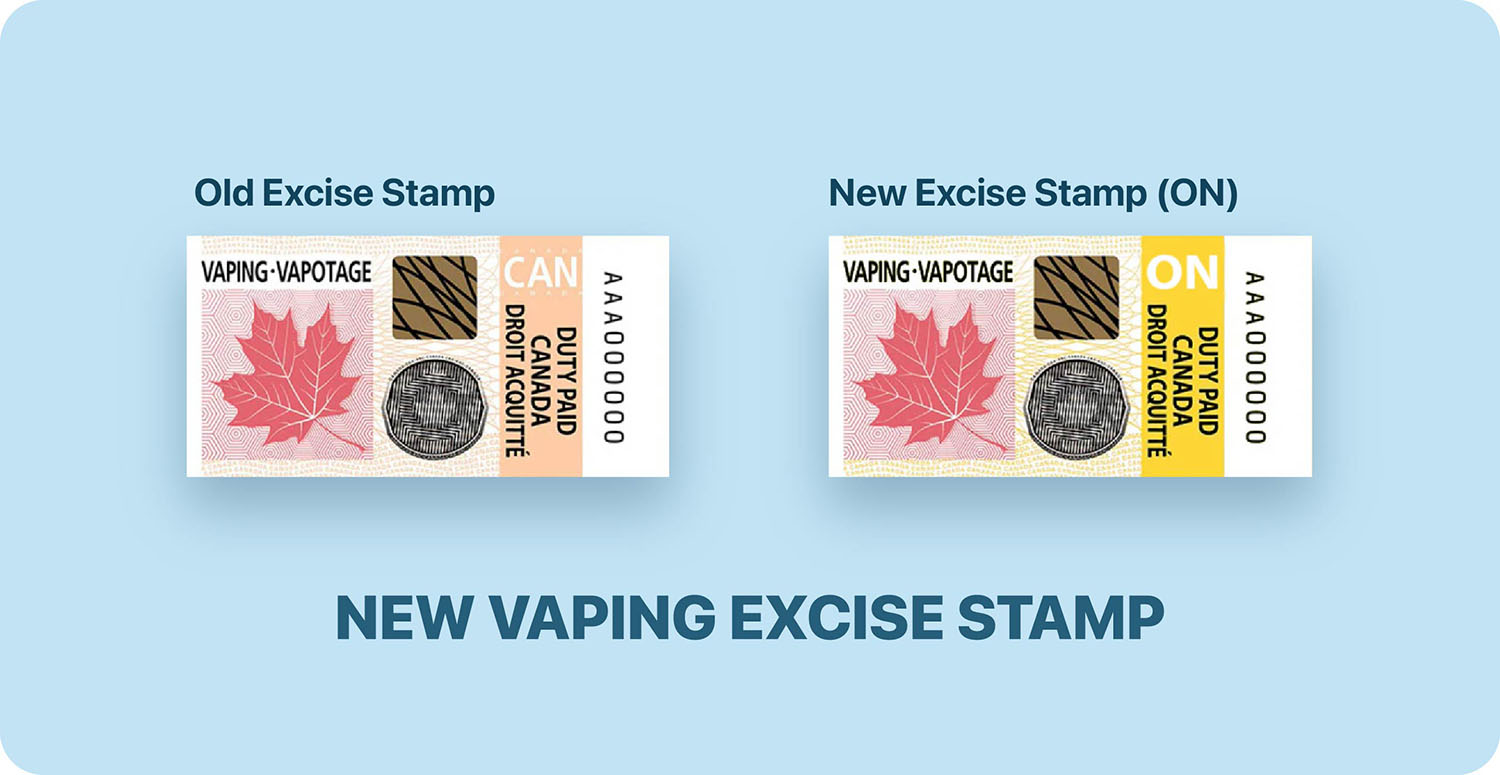
Pursuant to the Excise Act, 2001 and related regulations, excise stamps serve as the mechanism evidencing that applicable vaping duties have been properly reported and paid. The excise stamping regime is administered by the Canada Revenue Agency (CRA). Eligible and registered persons may obtain excise stamps through CRA systems and must affix them to retail-ready packaging in accordance with prescribed requirements. Responsibility for stamping depends on the entity’s role within the supply chain, such as whether it acts as the importer, final retail packager, or a registered stamping participant.
From an operational perspective, unstamped vaping products may not be released directly into the duty-paid market. Where products are imported for domestic stamping, they are generally required to be placed in regulated storage before stamping, and a vaping product licence is required for lawful possession of unstamped inventory. Stamping and duty payment must occur within prescribed timelines, typically no later than the end of the second calendar month following packaging in Canada or release by the Canada Border Services Agency. For excise purposes, a vaping product is considered “packaged” when it is placed in its final consumer-facing container, including any immediate or outer packaging in which it is sold to consumers.
In addition to duty payment, registered persons are subject to ongoing reporting and record-keeping obligations. Supporting records covering manufacturing, packaging, stamping, inventory movements, sales, exports, and disposals must be retained for a minimum of six years. Non-compliance with excise stamp, licensing, or reporting requirements may result in enforcement action under federal law, including monetary penalties of up to CAD 500,000 and, in serious or wilful cases, criminal liability that may involve imprisonment for up to five years. In coordinated provinces, excise stamps also support the execution of provincial additional vaping duties and may involve province-specific identification and inventory management requirements.
Learn More
Canada Vaping Market Snapshot 2026
TED Revision – European Commission Proposes Reform of Tobacco Taxation

 Previous