


FOLLOW US




Market Size and User Base (Рынок электронных сигарет)
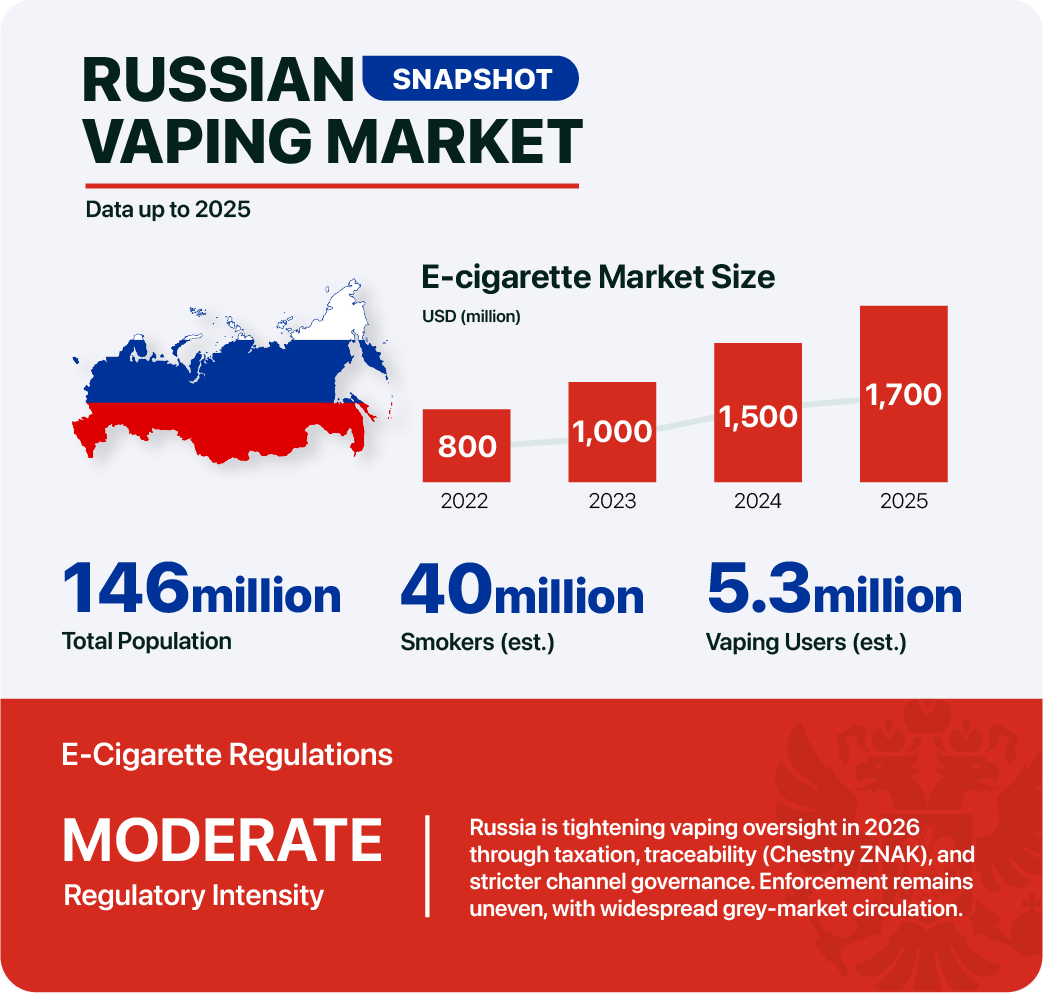
In recent years, the Russian vaping market has continued to develop amid tightening regulations and shifting consumer demand, gradually forming a relatively stable alternative nicotine consumption market.
Based on industry research and market estimates, Russia’s vaping market size in 2026 is projected to be around USD 2.0 billion. Despite an increasingly strict regulatory environment, demand for vaping products as an alternative among adult smokers remains relatively resilient.
Russia has an estimated 35 to 40 million adult smokers, providing a sizeable potential consumer base. Entering 2026, the number of vaping users has reached approximately 5.6 million, indicating that vaping continues to penetrate Russia’s adult smoking population.
Regulatory Developments in Russia (Законодательство в вейпинг-индустрии)
For many years, Russia’s vaping market operated under relatively loose regulation with uneven enforcement, contributing to the expansion of grey-market distribution. Entering 2026, regulatory tightening has accelerated, and the overall policy direction has become increasingly uncertain. In this context, 2026 to 2027 may represent a critical window for vaping brands to capture remaining growth opportunities before further restrictions take hold.
Russia has been gradually strengthening its taxation framework for vaping products. Excise duties on e-liquids reached RUB 44 per milliliter in 2025, with further increases scheduled to RUB 46 in 2026 and RUB 48 in 2027.
Russia’s national digital traceability system, Chestny ZNAK, has become a central regulatory tool for nicotine-related products. Vaping products entering the Russian market must complete digital marking registration and activate traceability codes before circulation; otherwise, they cannot be legally sold.
Packaging and labeling requirements are also becoming more standardized. Products are typically required to display health warnings, ingredient information, manufacturer details, and importer identification.
Regulation of nicotine product sales channels has also tightened in recent years. Online sales of vaping products are prohibited nationwide, meaning that legal transactions must take place through physical retail channels.
At the same time, e-commerce platforms and social media networks have strengthened restrictions on the promotion and advertising of vaping products. Offline retail compliance requirements are also increasing, covering areas such as product registration, tax reporting, and authorized distribution.
Beyond federal regulation, some regional authorities in Russia have started to introduce stricter local restrictions. Perm Krai, for example, has approved a regional law banning the retail sale of vaping products from March 1, 2026.
Although these measures remain regional rather than nationwide, they point to a clear direction of travel. Together with increasingly visible anti-vaping signals at the federal level, they suggest that the Russian market is entering a phase of tighter regulatory control and higher compliance requirements.
Product Structure and Main Product Forms
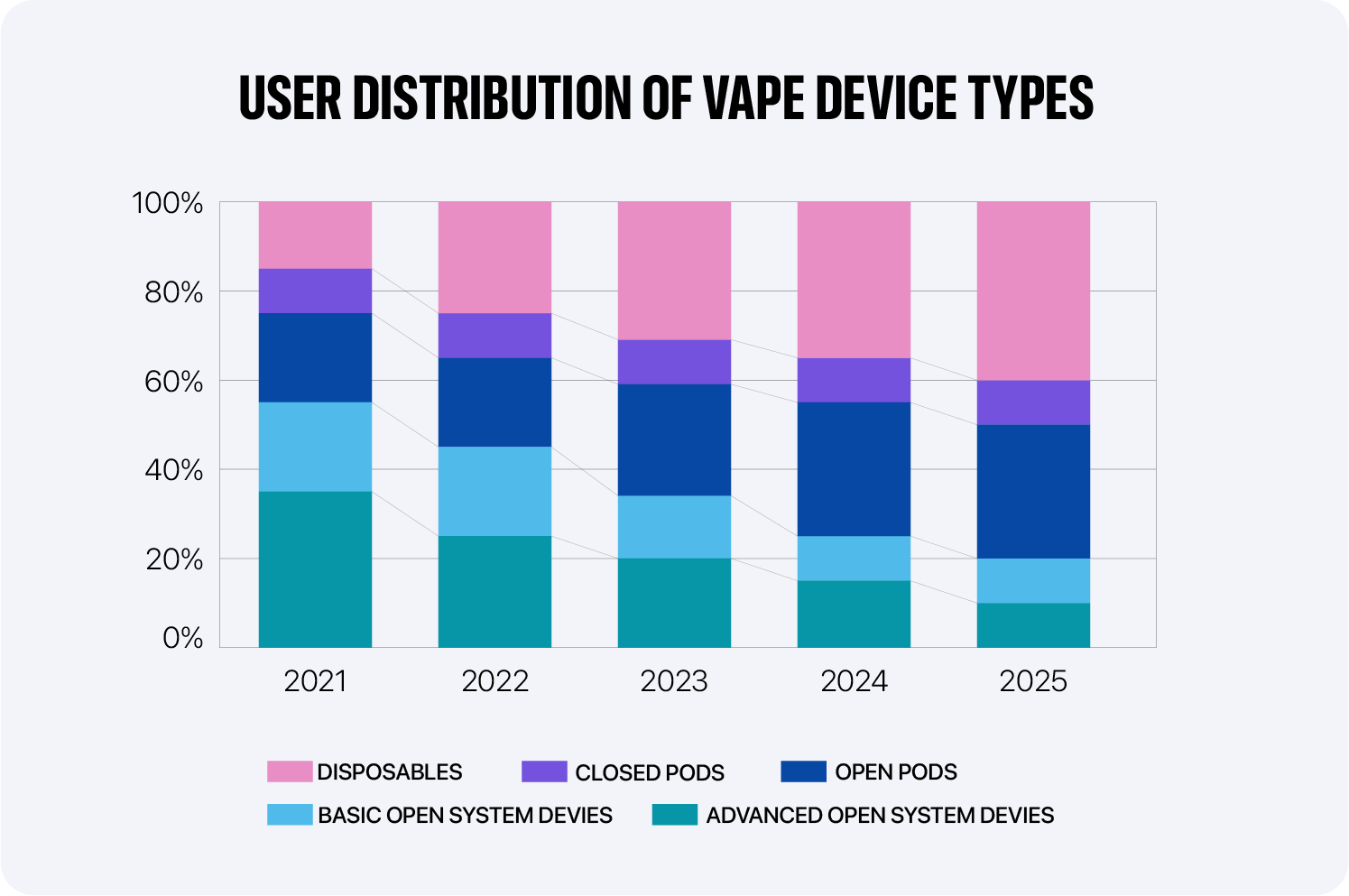
In 2026, device usage shares in the Russian vaping compliance market are estimated as follows:
• Disposable Vapes: 60%
• Open-systems & E-Liquids: 30%
• Closed Pods: 10%
Disposable Vapes
Mainstream products generally emphasize high capacity and long battery life. While 10,000 to 20,000 puffs remains a common range in the market, some recently launched products, especially from brands like Geek Bar, now exceed 30,000 puffs, with the highest models reaching 50,000 puffs. Battery capacity is often 650mAh or above, to better fit usage conditions, including colder climates.
However, as excise taxes continue to rise, cost pressure on high-capacity disposables is increasing, and puff counts may gradually trend downward over time.
In terms of flavors, before further restrictions are implemented, the market is still heavily oriented toward iced fruits, berry profiles, mint, and energy drink-inspired flavors.
Average retail pricing is typically around RUB 1,000 to 1,800 per unit.
Closed Pod Vapes
Closed pod devies currently represent a smaller share but have shown some growth momentum. Mainstream products are closed systems with pod capacity generally around 2ml. Device batteries are often 500mAh or above, and some models support fast charging.
Average retail pricing is typically around RUB 2,500 to 4,000 per kit (device plus pods).
Open Systems and E-Liquids
Open systems still retain a solid user base in Russia, but the category has become more clearly segmented.
Within the open-system segment, open pods have grown rapidly in recent years, gradually replacing traditional MOD-and-tank setups and becoming the more mainstream form of open-system use.
Although open pods typically operate within a narrower power range, they are easier to use and replace, have a lower barrier to entry, and can meet most users’ everyday needs. With coils in the 0.4–1.2Ω resistance range, open pods can handle high-VG freebase e-liquids and are also compatible with nic salts. In addition, when paired with bar salt e-liquids, they can satisfy users who prefer disposable vape flavor profiles.
Large-bottle e-liquids primarily serve users of traditional open-system devices. In retail, 100 ml bottles are the most common format, typically offered in freebase 3 mg or 6 mg.
At the same time, nic salt small-bottle e-liquids aimed at new-generation open pod users are also commonly seen in retail, with a typical format of 30ml at 20mg. Flavor logic in this segment tends to align more closely with disposable-style bar salt profiles.
Large-bottle freebase e-liquid (100ml) typically retails at RUB 800–1,500. Nic salt e-liquids (30 ml, 20 mg) are generally priced at RUB 400–1,000 at retail.
Brand Landscape
Brand presence in Russia is diversified. In the device and disposable segment, some globally recognized brands have strong consumer awareness in Russia.
In the early stages of the Russian disposable vape market, HQD held a dominant position and was one of the most widely recognized brands.
However, in recent years, its market presence has declined significantly, as leading global brands such as Lost Mary, WAKA, and Puffmi have rapidly expanded and overtaken it in terms of consumer awareness and market influence.
Meanwhile, some brands enter Russia primarily via international wholesale routes, such as Vozol, Ignite, JNR, and Alibarbar, which maintain circulation in the disposable segment across certain price tiers.
Russia also has a meaningful number of local brands, such as HUSKY, PLONQ, BRUSKO, Inflave, and Gang, many of which rely heavily on regional wholesale networks and retail distribution.
In the e-liquid market, the majority are dominated by locally well-known e-liquid brands. Examples include Smoke Kitchen, VLIQ, Fummo, Rell, and Scandalist (Ruvapes), which are relatively well known among open-system user groups and maintain a steady retail presence.
At the supply chain level, Russia’s vaping industry remains highly dependent on China’s supply chain, covering device manufacturing, e-liquid production, atomization components, and the supply of flavor systems and certain key raw materials.
The Role of China’s Supply Chain in Russia
From a global supply chain perspective, China remains the primary source of vaping product supply for the Russian market.
According to China Customs statistics, China’s total vaping exports in 2025 were approximately USD 10.598 billion. Among these, exports to Russia were about USD 367 million, accounting for roughly 3.46% of China’s global vaping exports.
In December 2025, Russia rose to become China’s fourth-largest vaping export destination by monthly value, with exports of approximately USD 68.24 million that month.
China’s Guangdong region, especially Shenzhen and Dongguan, serves as the core export base to Russia, accounting for over 80% of China’s vaping exports to Russia. With a mature industrial ecosystem, manufacturers can support a stable supply and customization for the Russian market.
Market Outlook
Considering regulatory changes, demand structure, and supply chain dynamics, Russia’s vaping market is expected to show the following developments in 2026–2027.
Product Structure Adjustment
Disposables are likely to maintain a significant share, but growth may shift from single hero SKUs toward a more diversified portfolio mix.
At the same time, the open-system e-liquid market may face increasing influence from international vaping brands. As disposables become more pervasive, the modern Bar Salt flavor is gradually reshaping the flavor preferences of open-system users, pushing changes in flavor logic and product structure within the e-liquid segment.
Grey Market and Inventory Flow Effects
Products relying on grey-market circulation may face greater pressure. For example, a large volume of disposable inventory accumulated in the US under regulatory pressure could flow into Russia via grey-trade routes.
Such inventory typically enters channels at lower pricing. This can disrupt local price structures and, in the short term, reshape channel competition dynamics. Some distributors may prioritize fast-moving inventory sources due to margin and turnover considerations, compressing shelf space and pricing power for products supplied through standard routes. This can affect channel stability and market rhythm for certain brands.
Changes in Supply Chain Collaboration
Under sustained regulatory and cost pressure, distributors tend to prefer brand and supply chain partners that can provide a stable supply, complete SKU structures, and strong compliance adaptability. Collaboration may gradually evolve from simple supply relationships toward deeper coordination, including portfolio planning, inventory management, and supply chain efficiency improvement.
Overall, Russia’s vaping market is shifting from a phase of rapid expansion to one of structural adjustment, where competition will increasingly be defined by brand strength, portfolio structure, and supply chain execution.
Against the backdrop of these shifting trends, the Russian vaping market is undergoing profound structural changes, creating significant new growth opportunities for e‑liquid products. To seize these emerging opportunities, partnering with a capable and reliable e‑liquid manufacturer has become more critical than ever.
HANGSEN GROUP - World’s Leading E‑Liquid Manufacturers
Hangsen is one of the world’s leading e‑liquid manufacturers, with annual shipments of e‑liquids and flavor ingredients exceeding 5,000 tons.
As a long-term key supplier to the Russian market, we have built an in-depth understanding of local product trends, regulatory dynamics, and consumer preferences.
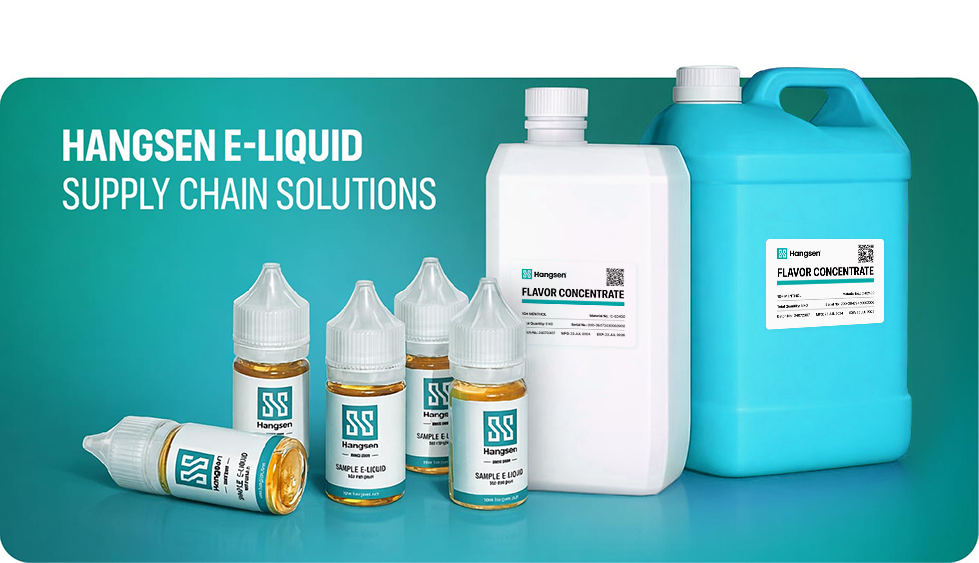
We provide a comprehensive one-stop e-liquid supply chain solution, covering everything from flavor raw materials to finished e-liquid products, as well as bulk e-liquid for prefilled pod & device filling.
If you are seeking a tailored, stable supply chain solution for the Russian market, please feel free to contact us.
Наши клиенты включают производителей жидкостей для электронных сигарет, оптовых дистрибьюторов, бренды электронных сигарет, производителей вейп-устройств, а также компании, заинтересованные в OEM-производстве жидкостей для вейпа.

 Previous