



FOLLOW US


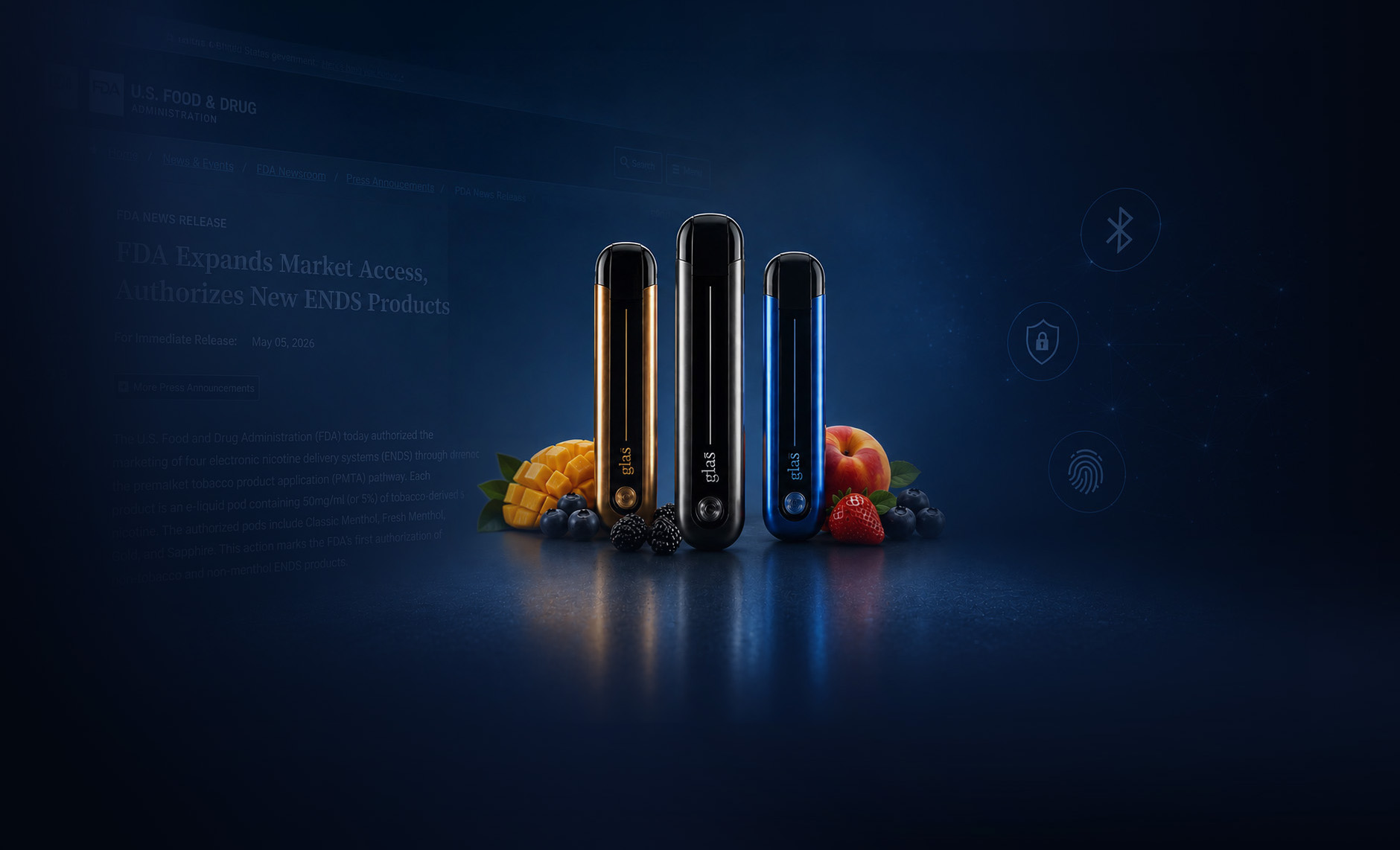
In May 2026, the U.S. Food and Drug Administration (FDA) announced that it had granted Marketing Granted Orders (MGOs) through the PMTA pathway for four ENDS pod products submitted by Glas Inc., allowing them to be legally marketed in the United States. The authorized products include Classic Menthol, Fresh Menthol, Gold, and Sapphire, all of which are pod-based ENDS products containing 50 mg/ml, or 5%, tobacco-derived nicotine. Among them, Gold is mango flavored, while Sapphire is blueberry flavored.
This authorization also represents Glas’s second round of PMTA approvals following the authorization of the Glas G² Device and tobacco-flavored pod products in March 2026. According to the FDA official announcement, this marks the first authorization of non-tobacco, non-menthol flavored ENDS products in FDA history, as well as the first officially authorized fruit-flavored e-cigarette products under the PMTA system. An MGO is a marketing authorization order issued under the PMTA framework, indicating that the products were reviewed and found to meet the “Appropriate for the Protection of Public Health” standard required for legal marketing in the United States.
As of May 9, 2026, the FDA had authorized 45 e-cigarette products for legal sale in the United States. The Glas authorization also marked the first time fruit-flavored products entered the FDA-authorized e-cigarette product list.
PMTA Key Milestones
June 2009
The United States passed the Family Smoking Prevention and Tobacco Control Act, granting the FDA statutory authority to regulate tobacco products.
May 2016
The FDA issued the Deeming Rule, formally bringing e-cigarettes and ENDS products under federal tobacco regulation.
September 2020
PMTA became the primary legal pathway for ENDS products to remain on the U.S. market. Manufacturers were required to demonstrate that their products met the “Appropriate for the Protection of Public Health” standard.
October 2021
The FDA authorized the first e-cigarette product through the PMTA pathway, granting an MGO to R.J. Reynolds Vapor Company for the Vuse Solo device and its accompanying tobacco-flavored pods.
June 2024
The FDA authorized its first menthol ENDS products, including NJOY ACE Menthol and NJOY DAILY Menthol.
July 2025
Several JUUL tobacco and menthol products received MGOs, while tobacco and menthol categories continued to dominate the legal U.S. ENDS market.
March 2026
The FDA released its first draft guidance outlining PMTA evidence requirements for flavored ENDS products, with additional emphasis on youth risk assessments for fruit, candy, dessert, and other non-tobacco flavor categories.
May 2026
The FDA authorized four ENDS pod products submitted by Glas Inc., including the mango-flavored Gold and blueberry-flavored Sapphire products. This became the first officially authorized fruit-flavored ENDS product case under the PMTA framework.
Background of the Glas Fruit-Flavored Vape Authorization
Over the past several years, consumer demand for non-tobacco flavor categories such as fruit, beverage, candy, and cooling flavors has remained present in the U.S. market. However, within the PMTA-authorized system, approved ENDS products were primarily concentrated in tobacco and menthol categories.
During the rapid growth of disposable e-cigarettes, brands such as ELFBAR, Lost Mary, and Geek Bar continued driving the visibility and growth of non-tobacco flavored products. At the same time, unauthorized fruit-flavored products also continued to exist within the U.S. market.
This also reflects a long-standing structural issue within the U.S. ENDS market: compliant supply of non-tobacco flavored products has remained relatively limited, while market demand has not disappeared, leading a significant portion of consumer demand to continue flowing toward unauthorized products.
Key Factors in the FDA Review
According to publicly available FDA information, the review of Glas products involved product-related scientific evidence, adult usage data, youth risk mitigation measures, age-verification systems, marketing restrictions, and post-market surveillance capabilities.
A key feature of the Glas system is its device access-restriction technology. Users are required to complete government ID age verification through a mobile device and pair the product with an authenticated smartphone via Bluetooth. Some public reports also indicate that the device may not function normally when separated from the verified phone, while the system may perform random biometric verification checks to confirm that the actual user matches the registered account holder.
These access controls, together with FDA-required marketing restrictions, were part of the agency’s youth risk mitigation assessment. The FDA also required advertising, marketing, and promotional activities for the authorized products to remain targeted toward adults aged 21 and older.
The authorization remains based on PMTA evidence requirements and risk assessment. Adult demand for non-tobacco flavors, the potential role of these products in helping smokers transition away from combustible cigarettes, and youth initiation risks were all considered within the broader PMTA review framework.
Potential Impact of the Glas Authorization

 Previous