


FOLLOW US


.jpg)
.jpg)
Global E-Liquid Supply Chain Evolution
The structure of e-liquid supply chains has never been static. Instead, it has continuously evolved in response to market expansion, device innovation, and regulatory change. Across major vaping markets, this evolution can be broadly categorized into three stages.
Stage 1
Fully Import-Dependent Model (Pre-2015)
In the early stage of the industry, e-liquid supply relied primarily on imports of finished products. Core product capabilities were concentrated in overseas manufacturing hubs, while local markets mainly focused on distribution and channel development.
During this period, industry concentration was relatively high. Early pioneers with mature product systems and first-mover advantages occupied dominant positions. Chinese manufacturers represented by Hangsen and Dekang, leveraging stable product performance and international supply networks, became core e-liquid suppliers for multiple major vaping markets worldwide.
Stage 2
Localized Manufacturing Model (2016–2021)
As market scale expanded and local manufacturing infrastructure matured, many regions began promoting localized e-liquid production. By establishing domestic factories and procurement systems, enterprises sought to reduce dependence on imported finished e-liquids.
This phase accelerated the growth of local e-liquid manufacturing ecosystems and led to the emergence of numerous regional brands built entirely on local production and distribution capabilities.
Stage 3
Global Sourcing + Local Finished Product Manufacturing (2023–Present)
In recent years, the rapid global adoption of disposable and other closed-system devices has significantly accelerated product structure evolution and flavor update cycles. Expectations for formulation responsiveness, device compatibility, and execution efficiency have risen accordingly.
Under these conditions, supply chain models relying entirely on local flavor and formulation systems have begun to expose clear limitations. Raw material and flavor structures often lack sustained innovation and become stylistically fixed. Flavor performance struggles to keep pace with rapid device iteration. In addition, a lack of mature filling process capability and proven e-liquid to closed-system device compatibility has constrained the development of the local prefilled vape industry.
Against this backdrop, some forward-looking enterprises have begun to explore a shift from fully localized sourcing and production toward introducing mature flavor ingredients and formulation systems from China, the world’s largest e-cigarette manufacturing hub, while completing blending and filling locally. This approach allows enterprises to achieve higher product maturity and execution efficiency without rebuilding full R&D infrastructures.

Key Business Scenarios and Enterprise Needs
Within the current industry environment, manufacturers' demand has gradually converged around several representative scenarios.
Scenario 1
Rapidly Building a Local E-Liquid Supply Chain from Zero to One
This scenario typically applies to brands or distributors that have already established market presence and sales channels. As business scale and product portfolios expand, these enterprises begin evaluating local e-liquid manufacturing or filling operations to support the next phase of growth.
In practice, building or acquiring a factory is often only the starting point. Highly internalized supply chain models can quickly lead to high fixed costs and low operational flexibility. From an investment-efficiency perspective, constructing a complete local system covering flavor development, formulation, and R&D from scratch usually requires extended timelines and carries elevated uncertainty.
In contrast, using mature semi-finished flavor base liquids and formulas, along with locally sourcing and blending PG, VG, and nicotine, allows companies to establish scalable production more quickly. This method lessens dependence on scarce senior R&D talent, avoids heavy upfront investments in formulation R&D and manufacturing facilities, and provides advantages in operational risk management and cost efficiency.
Scenario 2
Strengthening Local Manufacturing Through Global Supply Chains
This scenario applies to e-liquid manufacturers that have already completed localization but are facing increasing competitive pressure. As markets enter mature competition phases, reliance on a limited number of popular flavors is no longer sufficient to sustain growth.
At this stage, competitiveness is not achieved through incremental optimization within existing local supply chains. Instead, it requires a higher-level reassessment of product capability architecture. By upgrading flavor ingredients and formulation systems and adopting more advanced international flavor methodologies, manufacturers can align more effectively with mainstream vaping styles, accelerate iteration cycles, and establish differentiation at the raw material and flavor-structure level, thereby avoiding inefficient low-level competition.
Scenario 3
Optimizing Import, Clearance, and Compliance Costs
This scenario is common among enterprises that historically relied on importing finished e-liquids. As regulatory requirements become increasingly stringent, the cost burden associated with importing finished products continues to rise.
Under a global sourcing and local manufacturing model, with compliance handled locally, shifting imports from finished e-liquids to flavor concentrate base liquid and semi-finished materials, while completing blending and filling locally, has become a more viable path. Without compromising product quality or flavor stability, enterprises can restructure cost models and significantly improve supply chain flexibility.
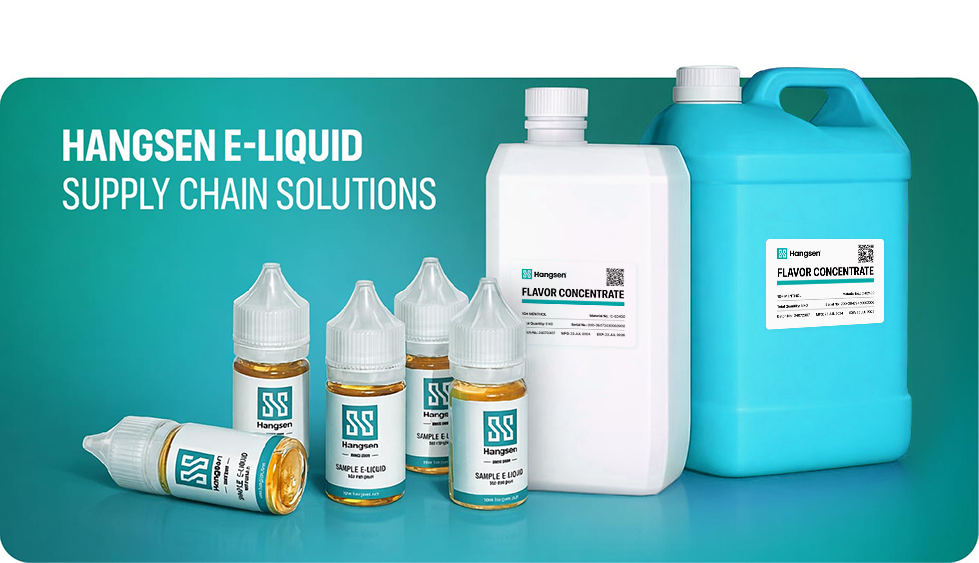
Hangsen E-Liquid Supply Chain Solutions
Based on long-term cooperation with leading international vaping brands and tobacco groups, Hangsen has developed a mature, highly reproducible flavor library and formulation system. This capability supports different stages of local e-liquid supply chain development, allowing enterprises to deliver finished e-liquid products at top-tier industry quality levels without rebuilding a complete R&D infrastructure.
Depending on the operational stage and local execution capacity, Hangsen provides several structured solution paths.
1. Semi-Finished Flavor Solutions
Under this model, customers receive pre-formulated flavor-based liquids in bulk form. By following clearly defined ratio instructions and adding standard components such as PG, VG, and nicotine locally, high-quality and scalable e-liquid production can be achieved using basic weighing and blending facilities.
This solution is particularly suitable for enterprises seeking to establish reliable product capability quickly without investing in full local R&D teams. It also allows manufacturers to optimize flavor style and overall product performance based on existing production assets, while maintaining consistency across batches and production lines.
2. Bulk Finished E-Liquids
Designed for enterprises with local filling and packaging capabilities. By completing packaging, labeling, and compliance processes locally, customers retain product maturity while gaining greater operational flexibility and improved execution efficiency.
3. Finished E-Liquids
This category offers a comprehensive selection of compliant, retail-ready e-liquids available in various specifications and nicotine strengths. The range includes standard finished liquids, shortfills, longfills, and flavor concentrates in complete, shelf-ready packaging. Designed for customers seeking rapid market entry, these products have undergone extensive commercial validation and regulatory alignment across multiple international markets, ensuring they are ready for immediate on-shelf sales.
4. Supporting Technical Guidance
In addition to product supply, Hangsen provides technical guidance covering key blending ratios, critical operational points during e-liquid processing, and device adaptation considerations during filling and application stages. This support is intended to facilitate local execution and reduce trial-and-error costs, rather than replace customers’ production management.
Industry Outlook
Industry rules are undergoing a structural shift, and competitive advantage is increasingly determined by the ability to optimize and integrate the supply chain. In this context, integrating mature international flavor and formulation systems represented by Chinese suppliers with localized execution models has emerged as an industry direction driven by efficiency, cost optimization, and value creation.
For further information regarding flavor ingredients, formulation solutions, or technical support, please contact [email protected].


 Previous